
Understanding Local Action as Systems Change
How systems thinking can help communities understand and shift the webs of power shaping their places.
“Even the smallest local action - the simplest place-based action we’re making is systems change.” - Chris Blake
Systems thinking as an approach to local change can often feel abstract. A lot of this “thinking” can end up in complicated maps, removed from the reality of places and the very real issues experienced in our daily lives. However, it is in our daily lives and it is in our places where systems and their outcomes actually play out. And therefore, it is place where systems change becomes possible.
In our February Knowledge Share Session, the Living Places Network welcomed Chris Blake, Chair of Trustees and Lecturer at Black Mountains College. Chris shared with us how we can utilise and bring systems thinking down to the locality. In this article, we share the insights we gained, exploring how creative systems thinking tools, like power mapping, can help communities make sense of their realities, identify the flows of power that influence their places and find the key leverage points that can catalyse deep, transformative change.
What is a system?
“There is a living web that runs through us
To all the universe
Linking us each with each and through all life
On to the distant stars.
Each knows a little corner of the world, and lives
As if this were his all.”
(The Web of Life, Robert T Weston, 1-6)
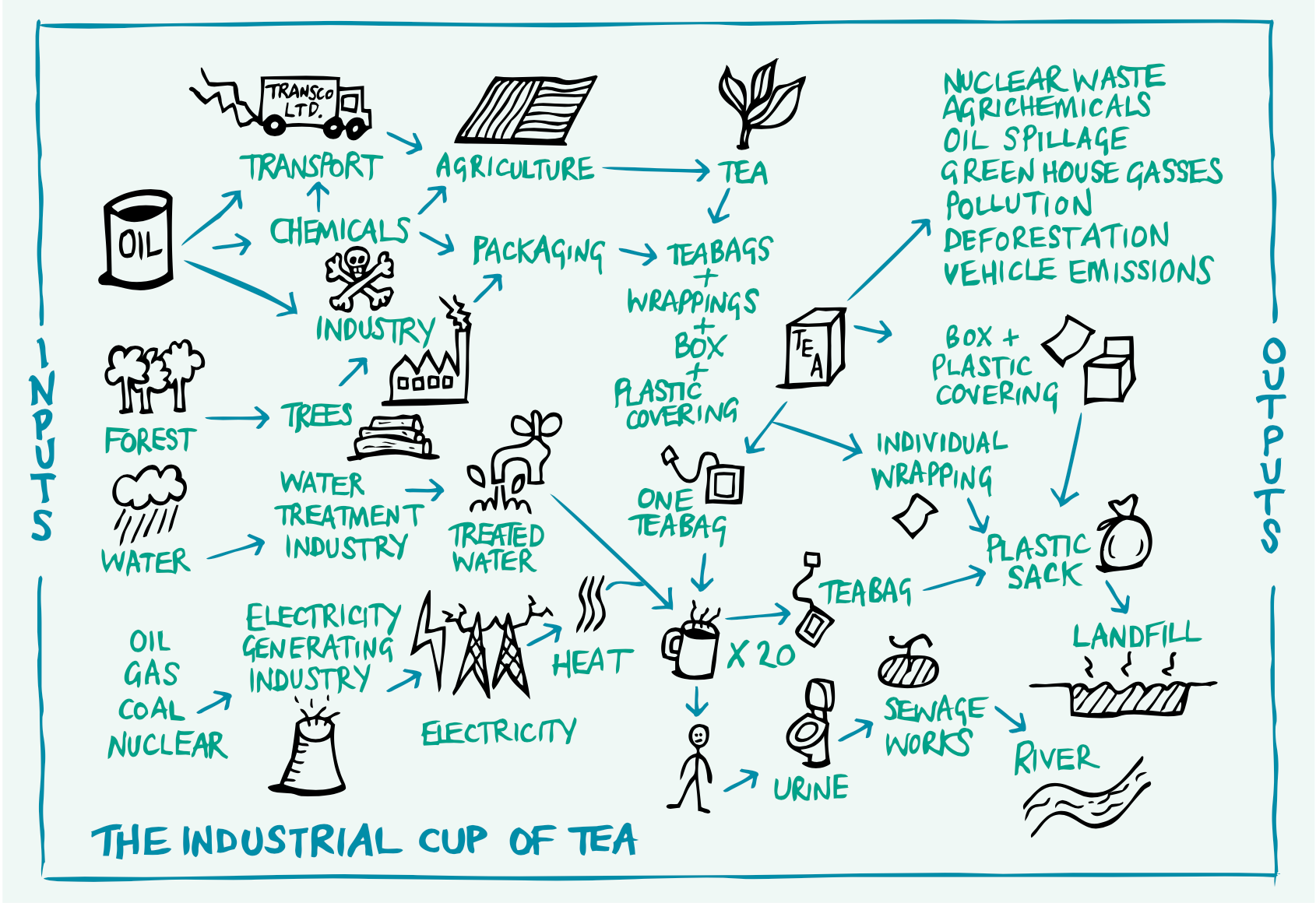
A system is a set of elements or things that create a functional whole. Everything that exists, exists within or because of a system. Nothing is truly independent. The cup of tea you had this morning did not exist in a vacuum, as the model below shows.
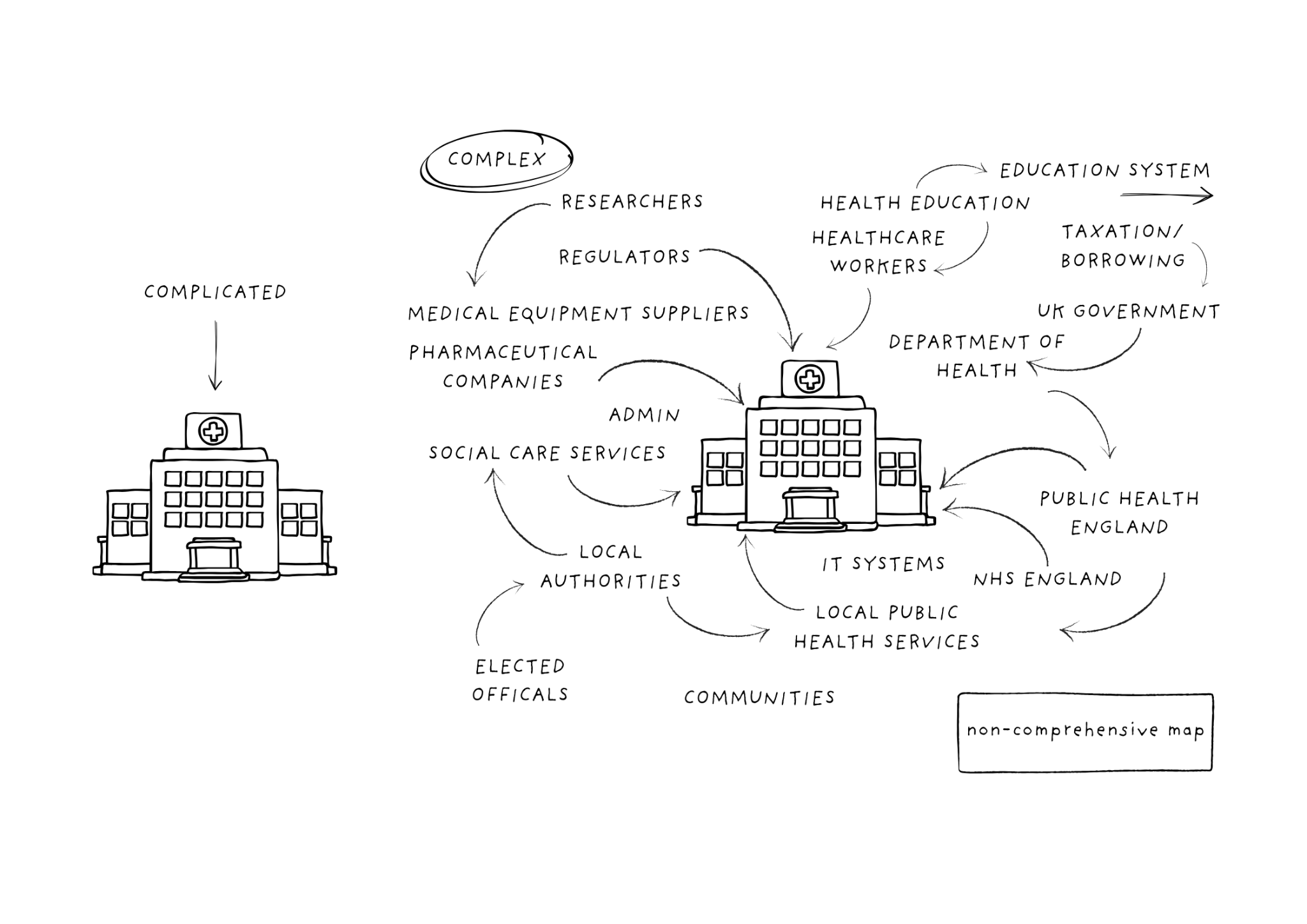
Some systems are complicated. Take, for example, the process of building a hospital. This in itself is complicated; it requires technical expertise, but it is linear, predictable and closed.
But then consider the healthcare system that the hospital sits within. This is a complex system - it is networked, adaptive and open. There are no rules, no processes and no definitive answers.
Complex systems are also dissipative. Meaning that they are alive, energy is in constant flux. A forest can be considered as a static structure, but energy is continuously flowing in and out of this structure. Light and water are constantly transforming, cycles of growth and decomposition are constantly moving.
It is these systems that we are working with as part of place-based change.
Why would a system need changing?
“The fundamental point about systems change is if we don’t like the outputs [of a system], then we want to change the system.” - Chris
As Chris shared, we tend to focus on the physical outputs of a system, we push against the “boulders” - environmental pollution, a big commercial project, a health crisis. And in this way we miss the underlying flows of energy that are creating them.

Take localised river action. If a group is expending all its energy towards river clean-ups - if their attention is solely directed towards the pollution flowing downstream, the flow that produces the waste remains untouched. It will continue to accumulate day after day, activists will burnout and the river will tell the same story again and again.
Our recent Knowledge Share with Friends of the River Medway told us a story that started with community clean-up events but evolved into something significantly deeper and far-reaching. While the group continues with direct action methods, they simultaneously look upstream, challenging behaviours, policies and legal frameworks. Pollution becomes not the problem in itself but the output of a much larger system at play.
This multi-pronged intervention is systems change in practice, and it is this place-centred work that grounds the theory of systems change in reality.
Finding the Right Leverage Points
This brings us to the how. How do we change a system?
One way of understanding this is through the idea of leverage points. These are points within a system where a small shift can lead to bigger changes in how the system behaves. Donella Meadows (1999) developed a model that identifies 12 leverage points to intervene in a system (see below). Some intervention points can “tweak” the system, while others can produce fundamental shifts.
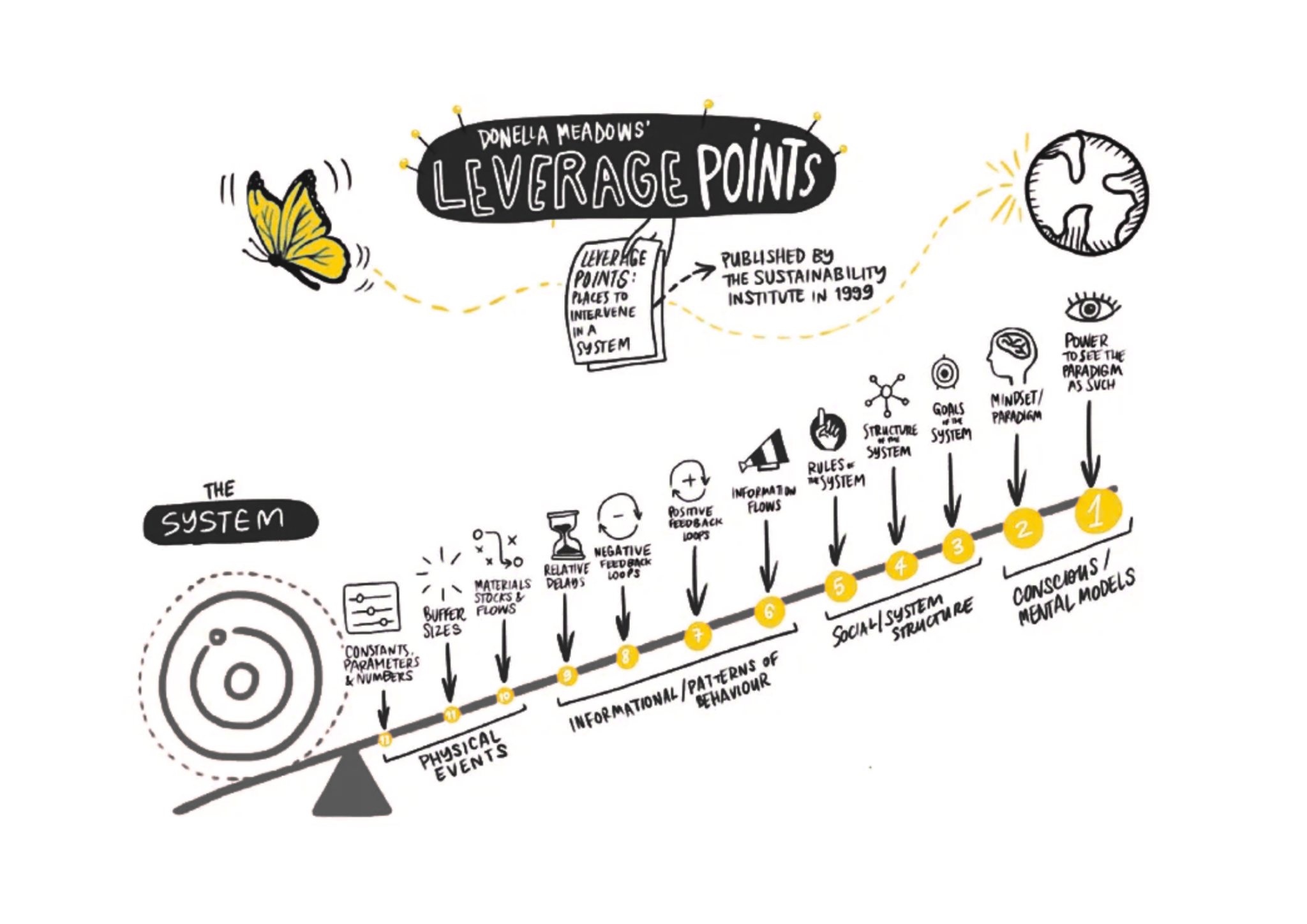
“If you want to make deep and lasting change to the system, you have to be right out on the end of the lever” - Chris.
This leverage point at the far right is about changing the paradigm or mindset that determines how the system operates, redefining the values that underpin it and dismantling the narratives that drive the system as it is.
Returning to the example of Friends of the River Medway, their work streams of practical and legal action are putting pressure on multiple points along this lever. However, in combination with this, there is a deep inner dimension that runs through all their work. Their stream of “sacred connection” is challenging the inner values and mindsets that shape how people relate to and interact with the river, and accordingly their behaviours as well. They are shifting the narrative from water as an extractive and disposable resource, to water as a living entity.
In turn, this is creating a shift from a system driven by profit, individualism and short-term gain, to something that is instead rooted in care, collectivism and long-term reciprocity.
The work of shifting values and narratives is systems change work. We can design interventions and solutions, but if we are not asking what underlying values, narratives and stories are driving a pattern, and how we can change these, we will keep reproducing the same outcomes.
Toolkit Item: Power Mapping
Place-based work by definition is about a particular geographical location, grounded in a reality and bounded within a locality. With this, there is a risk of losing sight of the wider structures.
To help us step back, Chris introduced us to power mapping1. It’s a sense-making tool, a way to see the systemic context you are operating within, to map the flows of power and influence and to see where leverage points might exist.
This exercise involves identifying the main actors and the scales they are all operating at. These are all of the actors that have power and an influence on a place (even if they don’t recognise this).
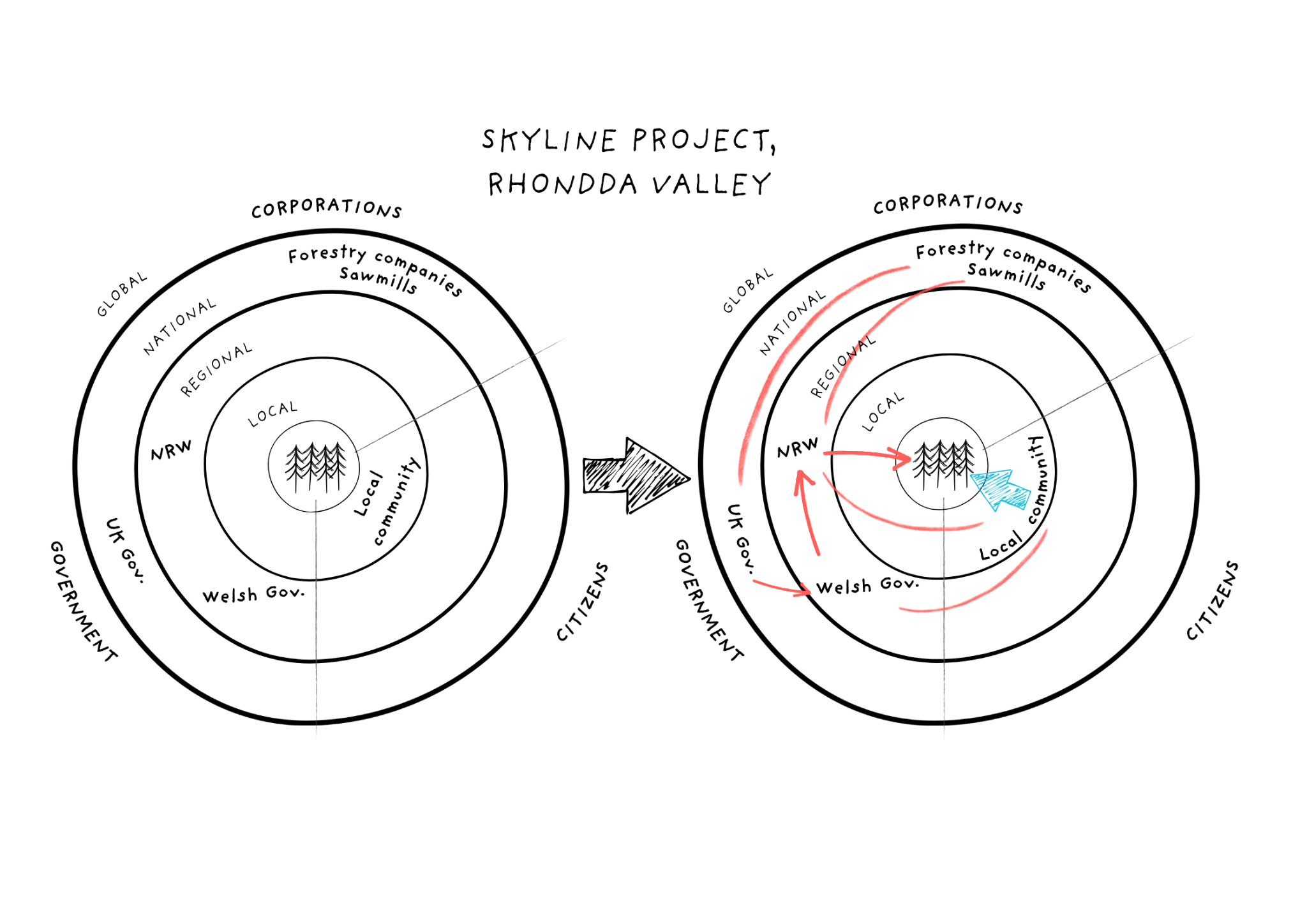
The power map below looks at Skyline, a project Chris has been working on for many years in the Rhondda Valley in Wales, to support the local community to take control of the commercial forestry that surrounds the town. Chris’s map shows us that only Natural Resources Wales (NRW) has direct control over this local forest. However, there is direct and indirect power associated with different actors, and understanding this web of influence is crucial.
NRW is managed by the Welsh Government, which is influenced by the UK Government, therefore, it can be suggested that government “values” have had the strongest influence over the management of the forest. This has been expressed through NRW and influenced by the business interests of forestry companies and saw mills through their lobbying powers.
In the session each of us honed in on our own contexts, from local food and energy systems, to water literacy and river restoration, we explored an interesting and varied range of examples where power mapping could be applied to help create strategies for systems change.
What we found was that these maps help to open up questions such as:
which actors need to be engaged
where energy, resources and attention could be best directed
where pressure could be applied to disrupt flows
where knowledge gaps exist
what interventions and pathways could be explored to shift the flow of power to the local community.
In the case of the Skyline Project, this has led to a co-production process between the local community and NRW. By creating new avenues for the community’s vision for the land to be expressed, the project is redefining the goals and values of the system surrounding the forest.
A key lesson that emerged here is that these maps don’t, or rather shouldn’t, be created in isolation. These creative tools are most powerful when they become part of a shared process through which communities can explore their own collective power and agency.
In practice, this can be simple. Book a village hall, partner with a community hub, lay out a large map or a blank sheet, and begin with questions. What’s happening here? What’s working? What feels stuck? Who is involved? Where is the power and influence flowing from? It’s a conversation about making sense of a place and what actions could emerge.
The aim is to offer communities the space to reflect on their lived experiences, to understand the systems or actors shaping their lives. Through this process, people begin to see how local challenges connect to larger power structures and systems, and crucially, how local action can influence and even shift these.
And this is a massive leverage point in itself. Bringing these conversations into everyday spaces shifts the stories about who gets to participate and shape what happens next, creating a sense of possibility and a pathway for structural transformation.
Power mapping can give us clues about where it might be best to prioritise our efforts but it certainly doesn’t give us answers. Small scale interventions can produce significant changes and ripple effects. Alternatively, a multitude of interventions at all scales and across the system might not shift anything at all. It is about testing and learning what works over time, and this will look different in different places.
Final Reflections
“Then, sometimes, as we look on unawares, the fog lifts
And there’s the web in shimmering beauty,
Reaching past all horizons. We catch our breath;
Stretch out our eager hands, and then
In comes the fog again, and we go on,
Feeling a little foolish, doubting what we had seen.
The hands were right. The web is real.
Our folly is that we so soon forget.”
(The Web of Life, Robert T Weston, 17-24)
By taking a systems approach to community-led work, it opens up new possibilities. From this arises an understanding of where power resides, how it flows and where small, intentional shifts can create waves of movement across a system.
The short mapping exercise in our session with Chris showed us how systems in our communities could be visualised, understood, and connected directly to day-to-day activities.
We need to bring these conversations out of distant institutions and into everyday spaces. Simple tools like power mapping can help communities collectively see their places within the wider web of life. They can help us design strategies for change that not only address visible challenges but also disrupt the underlying flows of power and influence shaping our places.
A key point to bear in mind with systems mapping is positionality. As an actor mapping a system, we must recognise where we sit within it and how our individual levels of power and privilege influence perception and analysis.
Power mapping sounds like a really helpful tool. Great article 👌🏻