
Rooting For The Future
Daisy's reflections from Groundswell
In May 2026, This Living Place welcomed Daisy Turner to our team as a Community Food Resilience Coordinator. Through a partnership with the Youth Environmental Service and two incredible community food projects, Off-Grid Organics and Skool Beanz, we have created this 12-month land-based placement that strengthens existing food projects, while creating a paid entry pathway into regenerative farming for a local young person.
Over the past few years, This Living Place has been working closely with some of Somerset’s smallest, women-led community food projects. These projects are building the foundations of our local food system, often with very limited resources, while balancing food production, community work and climate resilience. At the same time, so many young people in rural places face some of the highest barriers to employment.
We designed this placement as a practical intervention to help local growers overcome the structural barrier of not having the capacity to train or support someone consistently. By investing in the resilience of these projects, we are building the conditions for meaningful, long-term, land-based livelihoods to actually take root here and we are demonstrating what it looks like to embed a young person directly into the local food system.
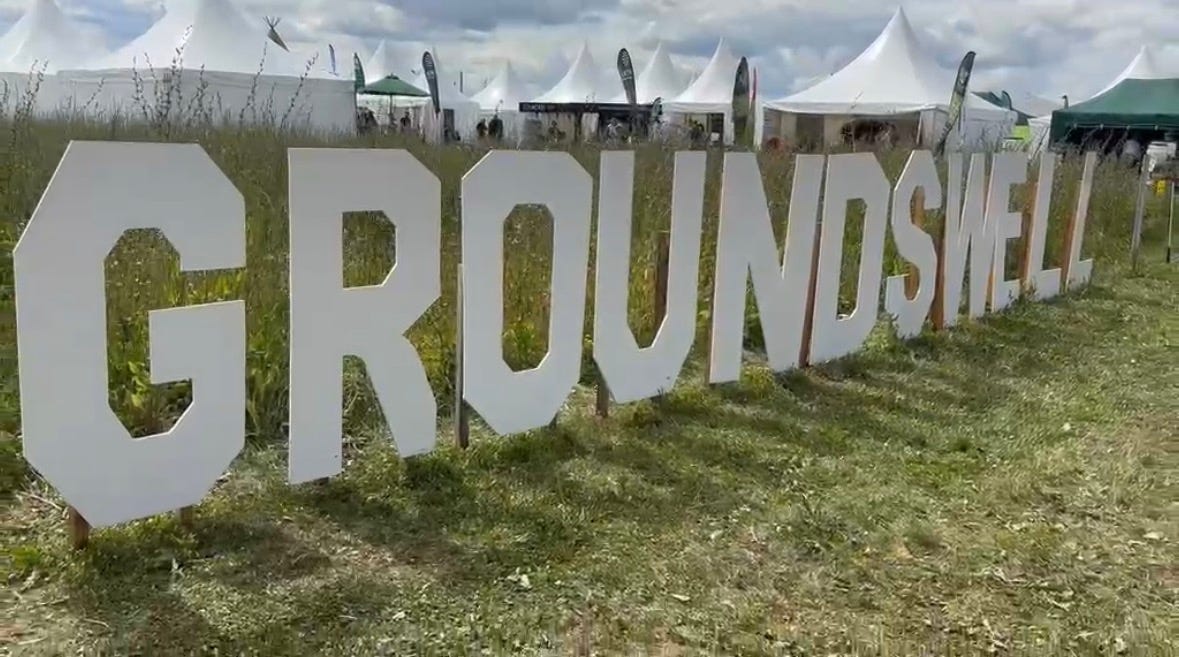
Earlier this month, Daisy had the opportunity to attend Groundswell, a two-day regenerative agriculture festival that provides a forum for farmers, growers and anyone interested in agroecological systems to learn about producing food and fibre while regenerating the soil and land. Below, Daisy shares her reflections from the event.
The Journey
After the incredible early-summer heatwave that had been plaguing the country’s farmers, I found myself waking up at the crack of dawn to harvest salad before the sun could wilt the leaves. Exhausted, I finally tackled some long-procrastinated packing before my dad, having had enough, bundled me and my scrambled-together belongings into the back of our beaten-up motorhome.
Growing up on a working farm, I never actually imagined I’d end up farming. To me, it seemed like a guaranteed recipe for stress... I also noticed a shift in the local wildlife, with the glowworms we used to hunt for on summer evenings becoming harder to find. It was a stark reminder that something about our approach needed to change. With a background in conservation, my dad started to feel that the farming methods he’d inherited didn’t quite sit right with his values anymore. He’d heard whispers of a ‘new but old’ way of farming—a method that was beginning to reemerge…
He started attending Groundswell in its early years and finally felt like he’d found “his people.” He returned home with a positive, nurturing community eager to help him on his journey—a far cry from anything he’d experienced in the conventional farming scene.
When my dad first told me about this, I was knee-deep in my degree and hunting for a dissertation topic. I knew I wanted to focus on the environment but felt confined by the social sciences aspect of my course. Inspired by this nature-friendly approach, I decided to research the benefits of “regen ag” on farmer well-being, hoping to find a non-financial incentive for the switch. This sent me down a sustainable farming rabbit hole, defying every expectation I had for my future. I soon found myself completing a Permaculture Design Course and volunteering on organic farms and market gardens across the world, which eventually led me to my role I am in today.
And after this 2-and-a-bit-year journey, I was finally able to go to Groundswell with my dad, having heard so much about it from him, my interviewees and others during this time, and learn even more about sustainable growing and farming. Off we went on our 4-hour journey to Hertfordshire, the rattling of some unidentified object the only music that our broken radio would allow, excited discussions about what talks we were going to attend as our only necessary entertainment, and thanking the farming gods that our aircon was somewhat working.
The Arrival
Stepping onto the site, I had a sudden, overwhelming feeling that I’d messed up—that I didn’t belong here after all. Despite the build-up, I was greeted by rows of gas-guzzling machinery and a sea of middle-aged men. My dad and I took a quick turn around the arena to get our bearings, but with the stands shut up for the night, a pit of dread grew in my stomach. I feared I was about to waste two days and a lot of money.
However, as we turned the corner into the food court, we hit a vibrant buzz of farmers, growers, and consumers of all shapes and sizes, all dancing to the same tune—literally. A small folk band was playing, clearly appreciative of the enthusiastic crowd. As I shook off the travel fatigue and joined the dance floor, I found myself grinning at my fellow boogiers. To my surprise, other young people were smiling—and cartwheeling—back. I couldn’t believe so many people my age cared about sustainable food; I hadn’t met many before this, but suddenly they were everywhere. My excitement reappeared tenfold. (Also, it turns out those middle-aged men are cracking dancers and lovely blokes!)
The following morning, we met a few bleary-eyed folk over breakfast, all mentally preparing for a day of learning after the previous night’s festivities. My dad and I planned to go our separate ways for the talks, but since nothing in the first hour jumped out at me, I tagged along to his session: “My Flour Mill Set Me Free” by Henry Astor. It turned out to be one of the highlights of the trip. Henry discussed the benefits of cutting out the middleman between farmer and baker, noting that the markup on flour relative to wholesale wheat is massive. By teaching himself to mill, he freed himself from government subsidies and regulatory restrictions, making his living purely from what he grew. It felt like a real solution for local growers in these crazy times—producing wholesale goods while creating a high-value product on the side.
Over the next two days, I realised the beauty of Groundswell is rooted in community. Every talk emphasised shortening supply chains to better connect farmers with consumers, and the importance of communicating openly about mistakes so everyone can learn together. It completely defied the “every man for himself” attitude I’d grown up assuming the industry had. It was a beautiful thing to behold. Seeing young women in this community treated with genuine respect for their knowledge was truly healing; I’m so excited to be a part of this and to keep building a knowledge base of my own.
The Party
And then there was the evening.
England had just won their World Cup match against the DRC, and spirits were high after what was reportedly the most diverse set of sessions Groundswell had ever seen. As the night drew to a close, The Earthworm Arms played host to Groove Armada’s Andy Cato, who spun rave music for the most unlikely group of ravers—who were absolutely loving it. The whole scene perfectly summarised the Groundswell experience: growers from all walks of life, united by one objective. To help the earth while feeding the world—and having a jolly good time while doing it.
I can’t wait for next year.


Learn more about our work on youth employment in rural areas here: